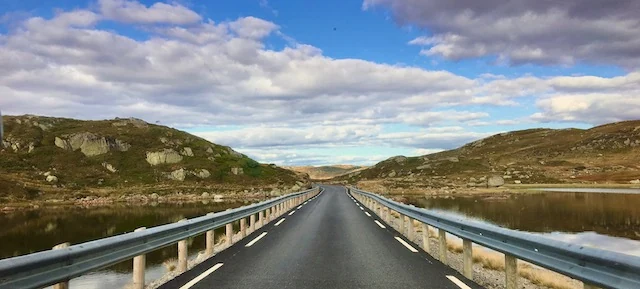
Some of the best days in Telemark begin without a trailhead. The road itself becomes the way of reading the landscape: open mountain giving way to birch and pine, lakes appearing below the road, old farms on steep ground and valleys narrowing until the next view opens again.
From Rauland, several drives are worth treating as journeys rather than transfers. They work on mixed-weather days, with children who need a break from walking, or simply when the point of the day is to see more of the region without rushing between attractions.
Austbygdi and the road toward Veggli
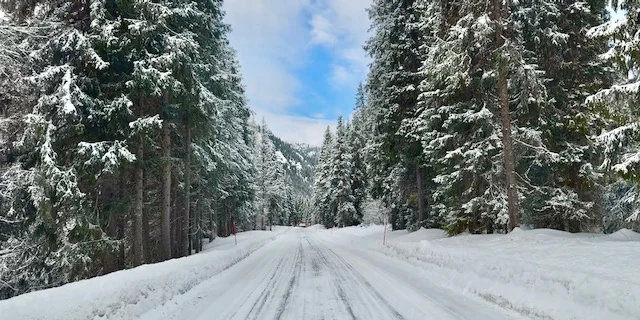
The drive toward Austbygdi leaves the high country gradually. The road drops toward Tinn, forest closes around it, and water begins to appear more often. At Austbygdi, the landscape opens at the northern end of Tinnsjø before the route east toward Veggli becomes quieter again.
This is not a drive built around one famous viewpoint. Its appeal is the sequence: winter forest and frozen water, summer farms and green valley sides, long stretches where traffic thins and the road feels much more remote than the distance suggests.
Tinnsjø, Mæl and Rjukan
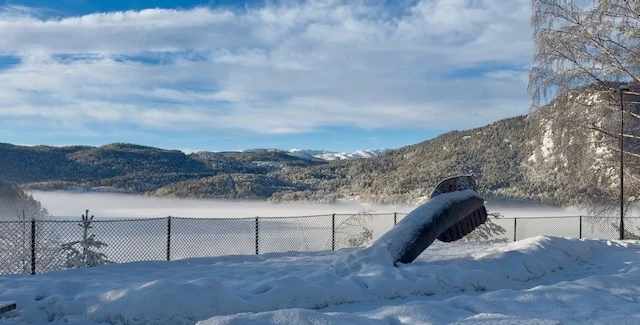
Heading toward Rjukan turns the drive into a history route. Tinnsjø sits deep between the mountains and was once part of the transport system that connected Norsk Hydro’s industrial operations in Rjukan with the wider world. At Mæl, railway wagons were transferred onto ferries for the crossing of the lake.
Continue into Vestfjorddalen and the road narrows toward Rjukan. Hydropower, industry and the steep valley walls begin to make sense as one story rather than separate sights.
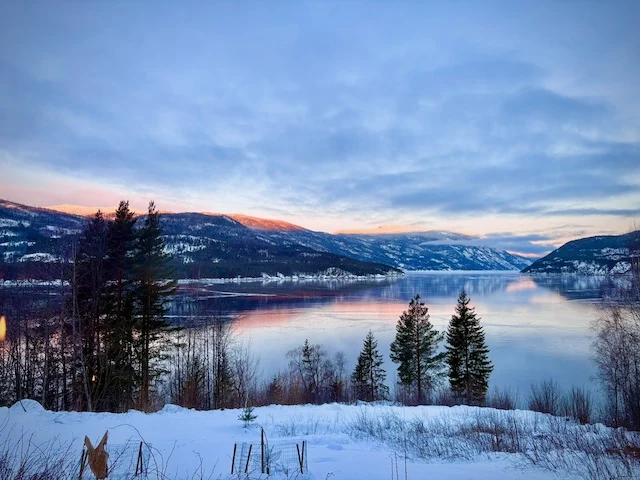
A good day here does not need every museum and viewpoint. Drive the lake slowly, stop at Mæl, continue into Rjukan and choose one main visit — Vemork, the town centre and sun mirrors, or Krossobanen. The road between them is part of the experience.
Down to Dalen and Lake Bandak
The road to Dalen gives one of the clearest changes in altitude and atmosphere. Rauland begins high and open; Dalen sits deep at the western end of Lake Bandak. The descent moves through thicker forest and steeper valley sides until the lake and village appear below.
Dalen itself deserves time. The hotel, canal history, Eidsborg and the walks above the valley make this a full-day direction rather than a quick turnaround. The descent works best when it feels like the first chapter of the visit.
The road toward Gaustatoppen
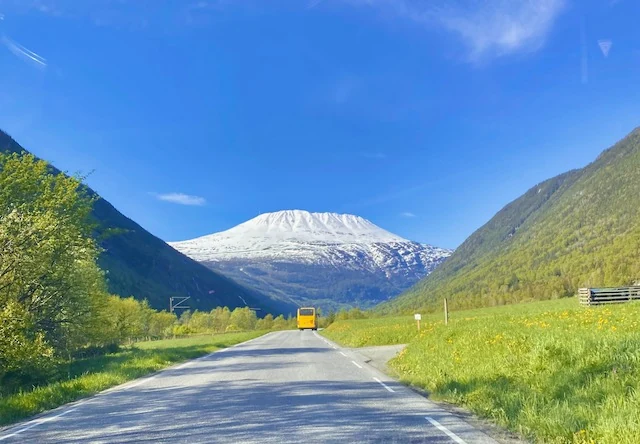
Gaustatoppen changes the horizon long before you arrive. From the Rauland side, the mountain appears and disappears between ridges, sometimes looking close enough to touch and sometimes vanishing entirely into cloud.
This is a drive where weather changes everything. In clear air, the mountain dominates the route. In low cloud, the final approach can feel completely different. Even without a summit hike, the high road and the changing views make the journey worthwhile.
One direction is enough
The easiest mistake is trying to combine too much. One destination plus the road is usually enough. Rjukan works naturally with Tinnsjø and Mæl. Dalen works with Eidsborg. Gaustatoppen works with a walk, Gaustabanen or a meal nearby.
For a half-day, choose one direction and turn back when the road has given you enough. For a full day, let one place anchor the route and use the journey to connect the landscape, history and small stops in between.